Foreign exchange differences
This article explores how IFRS 18 applies to the classification of income and expenses arising from foreign exchange differences, with practical insights into key application considerations.
02 Jul 2026 1 min read

IFRS 15 ‘Revenue from Contracts with Customers’ was jointly developed by the International Accounting Standards Board (IASB) and the Financial Accounting Standards Board (FASB) to align revenue reporting practices under IFRS and US GAAP. The objective of the standard is not to alter the definition of revenue, but to improve comparability by establishing a clear framework for recognising and measuring revenue.
Our ‘Insights into IFRS 15’ series summarises the key areas of the Standard, highlighting some areas that are challenging to apply in practice, to assist reporting entities in understanding how to apply IFRS 15’s requirements.
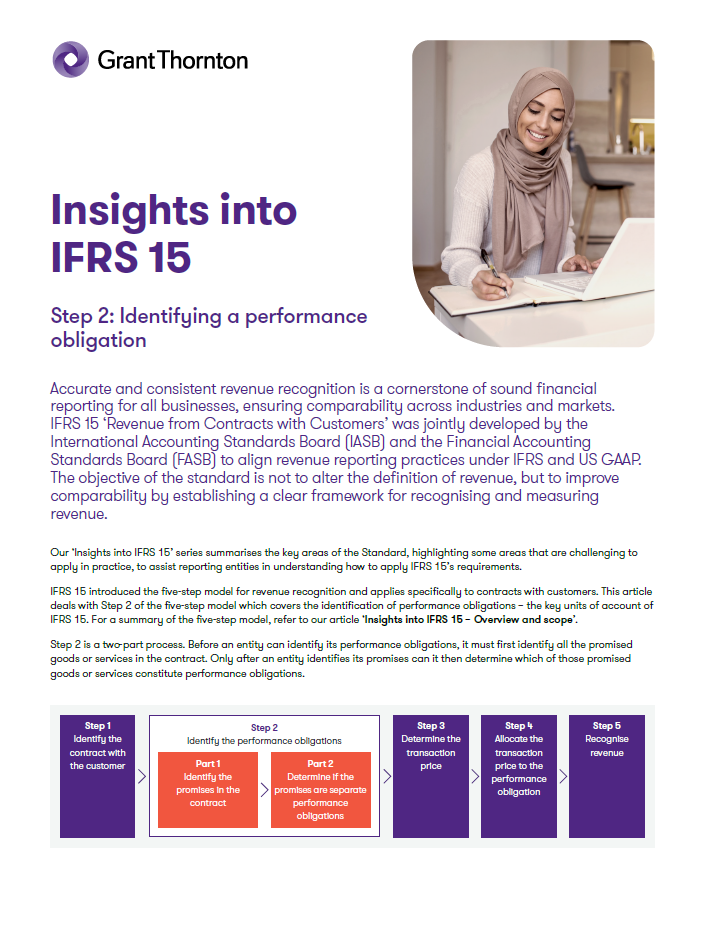
IFRS 15 introduced the five-step model for revenue recognition and applies specifically to contracts with customers. This article deals with Step 2 of the five-step model which covers the identification of performance obligations – the key units of account of IFRS 15.


This article explores how IFRS 18 applies to the classification of income and expenses arising from foreign exchange differences, with practical insights into key application considerations.

Our ‘IFRS Example Consolidated Financial Statements 2026’ publication provides practical guidance and illustrative disclosures to help reporting entities apply the latest IFRS requirements, including the early adoption of IFRS 18 and other changes effective for 2026.

Our ‘Insights into IFRS 2’ series explains the fundamentals of accounting for share-based payments and helps reporting entities navigate the complexities of the Standard. This article explains the accounting for group share-based payment arrangements, including their classification and the treatment of receiving and settling entities.